Public Engagement with Research
The last ten years have seen a series of attempts by policy makers to encourage universities to re-think and re-focus how they engage with wider society. Public engagement sits at the heart of these policy developments. Like Widening Participation (increasing access to Higher Education for the benefit of all), public engagement is driven by universities’ social responsibility to the wider public. (Outreach is another common term often used to describe WP and PE activities, as well as recruitment.) Public engagement is, by definition, a two-way process driven by a social responsibility, involving interaction and listening, with the goal of generating mutual benefit. In the 2010 Concordat developed by national research funding council RCUK (now UKRI), expectations were outlined for UK research organisations to have a strategic commitment to public engagement and outreach. It was also recognised that researchers should be recognised and valued for their involvement with these activities and enabled to participate through appropriate training, support and opportunities.
School-University Partnerships (SUPs)
Working within a school-university partnership is one approach to public engagement and can deliver many mutual benefits to all institutions and individuals involved.
These include:
• Increasing pupil performance
• Sharing of professional knowledge to improve pedagogy of activities and workshops
• Understanding of where research fits in with the curriculum and the modern world
• Access to the researchers of the future
• Collection of data for impact or to prove efficacy of a particular approach
• Training for school and university staff
The nature of such a partnership also means that these benefits can continue for successive groups of pupils, teachers and researchers. The successful formation of a school-university partnership poses a unique set of challenges and in 2013 the RCUK-funded School-University Partnership Initiative (SUPI) project began to attempt to address these. Nationally, 12 universities or HEIs were funded to work with local schools to investigate how successful partnerships could be created and maintained, and each has found different ways to address the initial call to ‘support researchers’ direct engagement with pupils, bring contemporary and inspirational research contexts into formal and informal learning and enhance and enrich the curriculum’.
Talk to US!
Talk to US! was the University of Southampton (UoS) SUPI project receiving funding from RCUK between January 2012 and December 2016. This Guide Book was developed as part of the Talk to US! Project and is based on the findings in the evaluation of its sub-projects.
Talk to US!, hosted by the Southampton Education School, focused on 6 STEM-based disciplines, some of which had existing engagement programmes that they wanted to enhance and some of which started from scratch, forming 6 sub-projects. The lessons learned are also very much applicable to non-STEM disciplines.
The 6 sub-projects were: Biological Sciences, Chemistry, Discover Oceanography at the UoS Waterfront Campus, Dragonfly Day engineering workshops for female pupils, LifeLab at Southampton General Hospital (SGH) and Murder in the Medical School run by the Biomedical Imaging Unit (BIU). Researchers and university staff were paired up with teachers from local schools with an aim of producing workshops and supporting curriculum based material that fitted into a particular model.
‘Now I know anyone can be a researcher no matter what age. If they just want to do something and they study hard, they’re a researcher. So I could be a researcher if I put my mind to it.’
Pupil from local school
This model was based loosely around the LifeLab programme and featured: introductory lessons around relevant subject material to be taught by teachers in school; a university visit day where pupils and teachers were able to use equipment or have experiences not available to them at school; following up with a project in school where pupils would produce academic style posters to be displayed at a celebration event at the end of the year.
In reality it very quickly emerged that this rigid approach did not fit every school or academic department involved for a variety of complex reasons and that flexibility and variety were more important. During the initial three years of the project it became clear that there was a very specific set of issues to overcome and knowledge needed to engage fully with this type of work. This
document is an attempt to address some of those.
How to Use this Document
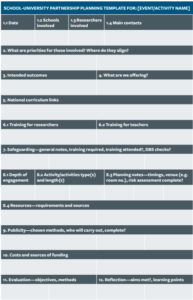
This Guide Book is intended to both enable university staff to initiate partnerships working with local schools and to aid school staff in making contact with a university they wish to engage with. The partnership is based around the creation of an initial activity. Ideally this activity will be planned in response to discussions between school and university staff to identify any mutual needs that can be met by partnership working. The planning template at the front of the document (page 3) highlights all the necessary steps.
Each section of the template has a corresponding section of advice and information in the Guide Book. Those with experience of partnership working or currently working within a partnership will be able to fill out the template by using these sections in a relatively light touch way. Those who are new to partnership working may wish to read each section of advice in full before continuing.
We recommend giving a copy of the Guide Book to your school/university contact. The majority of sections are relevant to all, particularly when planning collaboratively. Some advice, however, is more relevant to those coming from either a school or a university perspective and these sections are highlighted in the margins, with lime green/’S’ for schools and mid green/’U’ for universities.
Please note, this document has been put together based on working with UK schools and universities. All terms are explained in the Glossary so you can adapt as relevant for your contexts. A digital version of this document can be found at www.sotontalk2us.org.uk
Other Opportunities
There is already a lot of public engagement and outreach work going on at the University of Southampton and not only in STEM disciplines! If you wish to offer your expertise to an existing event or to find out what is happening that might be of interest to you, see the Useful Links and Contacts section.
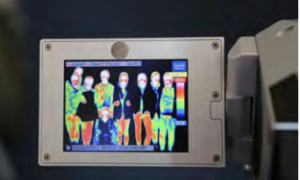
Local Guides see themselves through an infrared camera in a workshop about climate change during STEM Badge Day (a project developed from Dragonfly Day).
‘They couldn’t get over the fact that someone put this project on for them. They loved the fact that someone outside of our school was going to give them a day out, and link it to science and it was all different stuff that they’d never seen before. The fact that half the girls were scared of mud and ended up handling mud. It has more of an impact on those pupils because they don’t go out very often.’
Teacher on Discover Oceanography