
School-university partnership working can often count towards the various requirements, charters and other measures that both institutions have to align with. Showing clearly that the partnership work supports these is the best way to secure buy-in from senior management teams, enabling projects to take place.
How to write successful impact studies for REF based on school/university partnership working:
The REF is the UK’s system for assessing the quality of research in UK higher education institutions (HEIs). It first took place in 2014. It is conducted approximately every 7 years and gives HEIs access to large amounts of funding, as well as prestige in the sector. For more information see www.ref.ac.uk and the NCCPE website which has information on Public Engagement and the REF: www.publicengagement.ac.uk
An NCCPE analysis of 4 star REF14 impact case studies based on public engagement in general identified some key common factors. In all of these case studies the reasons behind the following were made apparent:
WHY was the engagement activity undertaken? What problem did it set out to resolve?
• Dissemination — Maximising the reach of the research into potential communities. Increasing awareness.
• Engagement — Creating meaningful and significant encounters with the research, tuned to the specific needs and interests of the user.
• Involvement — Using the insights and expertise of the user to inform outputs. WHO did you work with and why? Name groups specifically and give reasons why they have been identified.
• Publics — General public, communities of place, communities of interest or experience etc.
• Policy — Policy makers, regulators, funders etc.
• Practice — Charities, business, public sector etc. HOW did you engage with the groups you identified? Which model of public engagement was used?
• ‘Classic’ — Working specifically to ‘reach’ a particular chosen group.
• ‘Mediated’ — The focus is still on your chosen group but also involves some direct engagement with an intermediary organisation, for instance, to increase capacity or generate assets which can then be used by the chosen group in the longer term.
• ‘Blended’ — Where engagement with the public is one thread in a more complex picture of engagement activity.
• ‘Bolt-on’ — The primary focus is engaging with practitioners or policy makers but there is some public facing activity, usually to disseminate results or raise awareness. WHAT impact was achieved?
• Conceptual — Communicating meaning or creating meaning, leading to impact on attitudes and values, knowledge and understanding, or leading to enjoyment, inspiration or creativity.
• Instrumental — Changes in policy, products or services to better reflect a public’s needs or interests, achieve economic return, improve access to resources, and/or aid decision making. This is the easiest to evidence.
• Capacity building — Build on or gain new skills, improve health and wellbeing, change behaviours or professional practice, facilitate collaboration or progression.
Gatsby Career Benchmarks
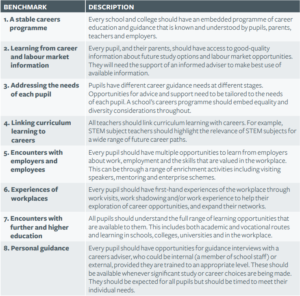
The Gatsby Career Benchmarks are a framework of guidelines that define the best careers provision in schools and colleges, and they form a key part of the UK Government’s Careers Strategy. Since 2018, statutory guidance to schools and colleges has included that they should be using the Gatsby Career Benchmarks to plan and improve their careers provision. The benchmarks are about ensuring that every young person has access to careers education, skills training, exposure to the full range of learning pathways and high quality, impartial careers advice and guidance.
Achieving the Gatsby Career Benchmarks in full is a challenge for schools and colleges, but school-university partnerships are particularly well positioned to help schools meet benchmarks 4 and 7, as described below. Aligning a project or activity to support these benchmarks will make it a far more attractive offer for UK schools and increase the chances of engagement and participation, as well as the impact of the project.
Gatsby Career Benchmark 4 – Linking curriculum learning to careers
• Benchmark 4 is about linking curriculum learning with possible future career pathways. Through collaboration with universities, schools can provide information and experiences that teach students about a range of careers that are linked to subject or curriculum areas. For example, the Murder in the Medical School and Discover Oceanography activities highlighted in the Spotlight case studies allow students from schools to learn about a range of jobs within a field, both academic and non-academic, whilst also developing skills such as fingerprinting, water sampling, or analysing data.
• Where universities are looking to run more intensive programmes with schools or colleges, they should consider the GCSE/A-level/ equivalent curriculum topic areas in their planning. Providing subject-specific resources for teachers and school or college staff to use in their lessons, is another great way to support this benchmark area. For examples from Southampton, explore www.sotontalk2us.org.uk/resources.
Gatsby Career Benchmark 7 – Encounters with further and higher education
• Gatsby Career Benchmark 7 highlights the importance of encounters with further and higher education. Specifically, it requires schools to provide meaningful encounters with universities. It is important to recognise that whilst visits to universities can be a valuable experience, they can also be time and resource intensive for both schools or colleges and universities. This benchmark is about more than just university visits and so it provides opportunities for universities to support this benchmark in a variety of meaningful ways. For example, workshops, activities or talks that can be delivered in-school or live-streamed; student or ambassador-led programmes; attending careers fairs – are all great ways to add value to a school-university partnership.
• Opportunities to bring students on-campus may include subject taster sessions or masterclasses, Open Days, revision support – any opportunity that allows young people to experience a different style of learning and to be exposed to people, equipment and resources that they may not have access to in their school or college.
• Events for parents or guardians and teachers can also support this benchmark – if key influencers better understand higher education pathways then they can champion this in school/ college and at home.
Any activity, event or resource, if carefully planned, can support schools in achieving several of the Gatsby Career Benchmarks, not just the two referenced here. However, it is also important to think about the university’s strategic aims in relation to student recruitment, access and progression, when building school-university partnerships. It is clear that partnerships between universities and schools are not only an effective means to ensure high quality and meaningful experiences for young people, but also can also have mutual benefits for schools, colleges and universities to achieve their strategic goals.
Written with the support of the University of Portsmouth Outreach Team
Office for Students Key Performance Measures
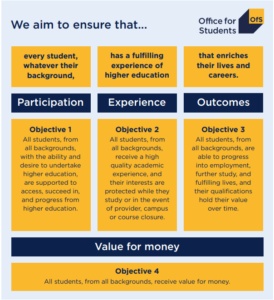
English universities’ widening participation targets are set locally but based on the national Office for Students’ four Objectives, which are divided into 26 Key Performance Measures (KPMs). The Office for Students are the independent regulator of higher education in England. Their overall aim is to, “ensure that every student, whatever their background, has a fulfilling experience of higher education that enriches their lives and careers.” and their work, “covers all students whether undergraduate or postgraduate, national or international, young or mature, full-time or part-time, studying on a campus or by distance learning.”
The four objectives are:
The 26 KPMs can be found at www.officeforstudents.org.uk/about/measures-of-our-success where:
• Participation – KPMs 1-7
• Experience – KPMs 8-14
• Outcomes – KPMs 15-18
• Value for money – KPM 19
• Efficiency and effectiveness – KPMs 20-26
Each university’s individual targets are detailed in their Access and Participation Plan and which can all
be found here: www.officeforstudents.org.uk/advice-and-guidance/the-register/search-for-access-and-participation-plans/#/AccessPlans